Iasos — a Carian port and treasure trove on Turkey’s Aegean coast
Iasos (İassos) — an ancient Carian city on the coast of Güllük Bay, one of the most picturesque and underrated archaeological sites in Aegean Turkey. Located in the province of Muğla near the modern village of Kıyıkışlacık, Iasos attracts visitors with its rare combination of ancient topography, well-preserved Hellenistic and Roman structures, and the distinctive “pink” marble that was quarried right here and shipped to Rome, Alexandria, and Constantinople. Once a thriving port with a rich history dating back to the Minoan era, today it welcomes travelers with the tranquility of olive groves, the sound of the sea, and the perfectly preserved layout of the agora, bouleuterion, and Roman theater. This is a place for those who love antiquity without the crowds and prefer “real” stone to reconstructed facades.
History and Origins
According to written sources, Yassos was founded in the early 1st millennium BCE by colonists from the Peloponnese who arrived from Argos; however, archaeological findings indicate that this area was inhabited as early as the Late Bronze Age, around the 15th century BCE. Minoan pottery and Mycenaean artifacts have been discovered at the excavation sites, indicating early connections with Crete and mainland Greece.
During the Classical period, Iasos was part of the Delian League under the leadership of Athens, paid tribute, and actively participated in Aegean trade. The city changed hands several times between Athens, Sparta, and the Persians during and after the Peloponnesian War. In the 4th century BCE, Yasos became part of the Carian satrapy under the rule of the Hecatomnid dynasty, with its center in Halicarnassus.
Hellenistic Golden Age
Following the campaigns of Alexander the Great, Iassos experienced a true golden age: it became the most important port in the eastern Mediterranean, a center for the extraction and processing of the famous Iassos marble (lapis Iassensis)—a marble with a characteristic pinkish-brown color and wavy texture, prized throughout the ancient world. This stone was used in the construction of the Roman Baths of Caracalla, in the cladding of the basilicas of Constantinople, and later even in Venetian palaces. Revenues from the marble allowed the city to erect massive fortress walls, an agora, a bouleuterion, gymnasiums, and sanctuaries.
Yassos is mentioned in the decrees of the Hellenistic kings and held the status of a “free city” under the Seleucids, Ptolemies, and Attalids. It retained a key role under Roman rule, was part of the province of Asia, and continued to supply marble for imperial projects until the 3rd–4th centuries CE.
Byzantium and the Middle Ages
During the Byzantine period, Iasos became a bishopric within the Metropolis of Caria. Several Christian basilicas were built within the city, and some of the ancient temples were converted into churches. The city survived the Arab raids of the 7th–8th centuries, but by the 12th–13th centuries it had fallen into decline and become depopulated. After the region was conquered by the Turks and Ottomans, a small fishing village called Asin Kurin arose on the site of Yasos, which existed until the early 20th century.
Modern Excavations
Systematic excavations in Yasos have been conducted by an Italian archaeological mission since 1960 under the auspices of the University of Bologna. Over the past half-century, the agora, bouleuterion, sanctuary of Artemis Astias, Roman theater, acropolis, early Byzantine basilicas, and extensive necropolises have been uncovered. Some of the finds are on display in the local lapidarium—a small open-air museum—and in the Bodrum Archaeological Museum.
We would like to highlight the contribution of the mission led by Doris Levy and later by Fela Necheldiar-Bollini: thanks to their work, the chronological sequence of construction was reconstructed, Minoan layers were identified, and epigraphic monuments were described. Over 200 inscriptions in Greek have been found at Yassos, including fragments of hymns in honor of Artemis Astias and honorary decrees. These epigraphic records make Yassos one of the most “voiced” ancient cities in the region: every stone literally speaks with the voice of its era.
Yassos Marble and Its Fate
The pinkish-white marble of Yassos has become the city’s hallmark. Quarries were located a few kilometers north of the polis; the quarried blocks were transported down to the port via specially constructed roads and loaded onto ships. The stone’s color ranges from warm pink to lilac-gray, and its wavy texture is clearly visible when polished. This marble was used in the temples of Ephesus, Pergamon, and Aphrodisias, and during the Roman era—in the emperors’ palaces and public buildings of the capital. Byzantine architects continued this tradition, and columns made of Iasos marble can be found in the Hagia Sophia in Istanbul.
Architecture and What to See
Yassos is divided into two distinct areas: the coastal town with its agora and public buildings, and the acropolis on a rocky peninsula jutting out into the sea. Between them lies an old Greek cobblestone street and fragments of fortress walls.
The Agora and the Hellenistic Bouleuterion
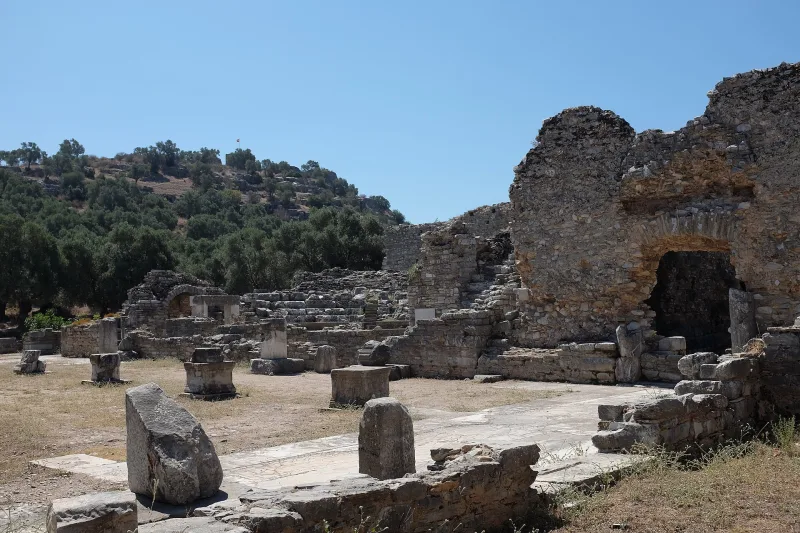
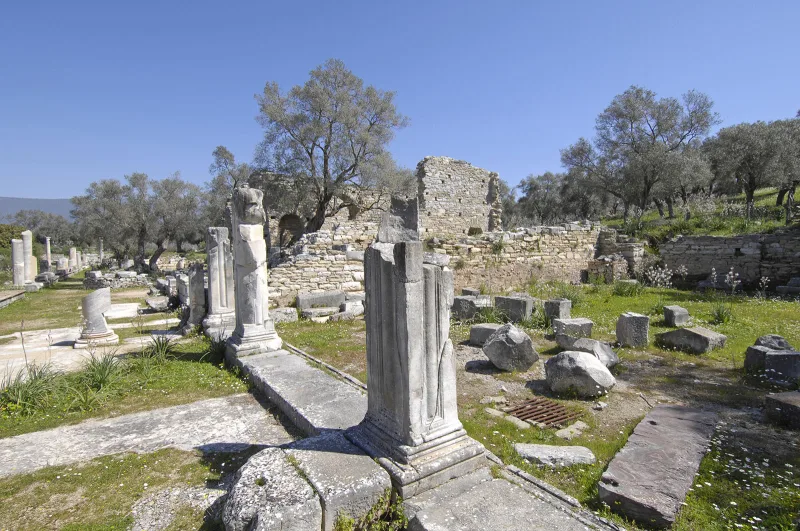
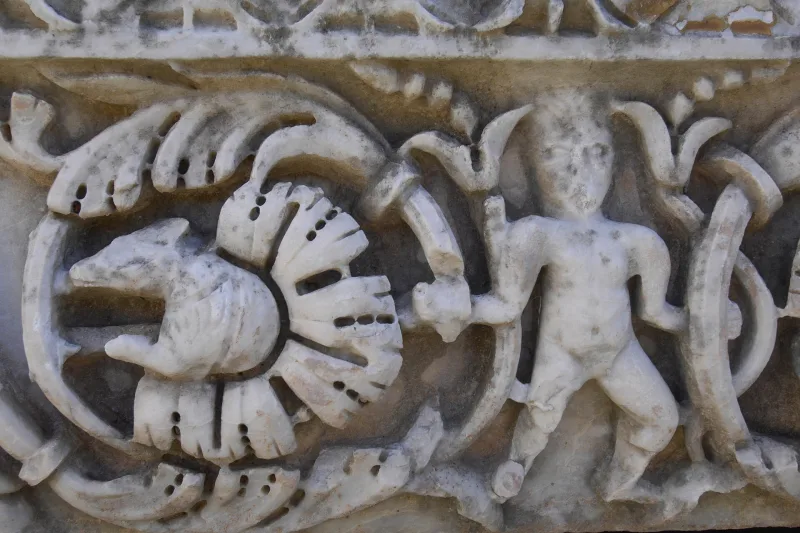
The Agora of Iasos is a vast rectangular square surrounded by colonnades with Doric and Ionic columns. A long frieze runs along its edge, featuring reliefs depicting garlands and masks—a characteristic Hellenistic motif. On the northern side of the agora stands the bouleuterion—the city council building—which is beautifully preserved: tiers of stone benches, the orchestra, and the lower wall of the stage are visible. It is one of the finest examples of bouleuterions in the Aegean region.
Sanctuary of Artemis Astias
The main religious building in Iasos was the sanctuary of Artemis Astias, the city’s patron goddess. The temple’s foundation, altar, and fragments of columns have survived. According to inscriptions, annual processions, athletic competitions, and poetic contests were held in honor of Artemis. Votive stelae and numerous offerings—figurines, pottery, and coins—have been found on the sanctuary grounds.
Roman Theater and Acropolis
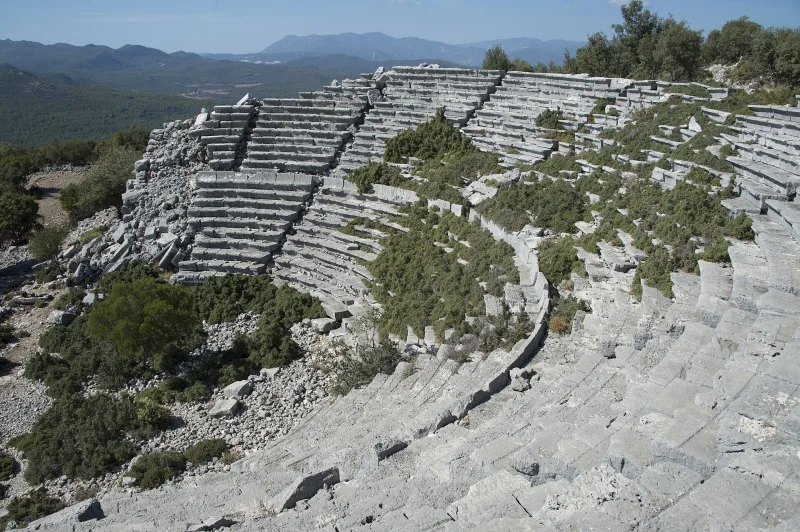
In the southern part of the city lies the Roman theater, built in the 1st–2nd centuries CE on the site of an earlier Hellenistic theater. The theater seated about 4,500 spectators and retains the lower tiers of benches, as well as part of the stage. The steps offer a view of the bay and the opposite shore. The acropolis on the peninsula is protected by massive walls with towers and was connected to the mainland by a narrow isthmus—it is a natural fortress, ideally suited for defense.
Early Christian Basilicas
During the Byzantine era, two basilicas (the so-called Eastern and Western) were built on the site of the ancient port. A mosaic featuring geometric and floral motifs has been preserved on the floor of one of them. The size of the churches and the quality of their decoration indicate that Yasos remained economically active at least until the 5th–6th centuries CE.
Necropolis and Sarcophagi
The northern slopes of the hills surrounding Yassos are occupied by an extensive necropolis from the Hellenistic and Roman periods. Here, marble sarcophagi, burial chambers, and stelae with epitaphs can be seen. Many of the sarcophagi are made of local pink marble and decorated with reliefs depicting garlands, bull’s heads, and masks. Some of the tombstones have been moved to the lapidarium, while the rest remain in situ—they can be viewed at any time.
Underwater Finds
In the coastal waters near the acropolis, submerged fragments of piers, quay walls, and supports are visible under certain lighting conditions. Part of the city went underwater as a result of seismic activity and rising sea levels. Divers can see the outlines of submerged streets and blocks of large buildings at a depth of 2–4 meters. Any underwater photography or collection of objects is prohibited: the area has been declared a protected archaeological zone.
Interesting Facts and Legends
- According to myth, the city’s founder came from Argos and brought with him a shepherd who was a prophet of Apollo to choose a site for the new settlement; dolphins indicated the location.
- Iassos marble (lapis Iassensis), with its characteristic pink hue, was prized throughout the Mediterranean and was exported as far as North Africa.
- The philosopher Hecataeus of Abdera (according to other sources, Hecataeus of Iassos) was born in Iassos, although the tradition regarding his connection to this particular city is disputed.
- The city suffered from earthquakes twice; one of them in the 5th century partially destroyed the fortress walls of the acropolis, and they were restored by the Byzantines.
- In the neighboring village of Kıyıkışlacık, ancient sarcophagi can still be seen, used by locals as troughs or house foundations.
- Wreckage from the Hellenistic and Roman periods is regularly found in the waters of Güllük Bay; some of the finds are housed in the Museum of Underwater Archaeology in Bodrum.
- In the 4th century BCE, according to Polybius, the inhabitants of Yasos managed to secure from the Persian satrap the right to mint their own coins—the silver tetradrachms of Yasos, featuring Apollo and a dolphin, are considered a numismatic rarity.
- Donation inscriptions by noblewomen have been discovered in the churches of Byzantine Yasos, attesting to active female philanthropy in the early Christian era.
How to get there
Yassos is located approximately 25 km southwest of the city of Milas (Muğla Province). The nearest airport is Milas–Bodrum (BJV), 35 km away. The most convenient way to get there is by rental car: from the D330 or D525 highway, follow the signs to Kıyıkışlacık. The road is scenic, passing through olive groves and small hills.
From Bodrum without a car: take a bus to Milas, then a dolmuş to Kıyıkışlacık. It’s a 5–10-minute walk from the village to the archaeological site. During the summer season, you can take a gulet cruise from Bodrum or Güllük with a stop in Yasos. If you’re planning a “Ancient Cities of Caria” itinerary, it makes sense to combine Yasos with Labanda, Euromos, and Stratonikeia.
Tips for travelers
The best time to visit is March–May and October–November, when it’s not too hot and the area is covered in spring flowers. In summer, the sun is strong and there’s little shade, so bring a hat, sunscreen, and plenty of water. A walk through the ancient site takes 2–3 hours; closed-toe shoes are required to climb the acropolis, as the acropolis is full of loose rocks.
In Kıyıkışlacık, there are several simple seafood restaurants; be sure to try the local grilled fish and meze salad. A camera will come in handy: the landscapes of Yasos with their coastal columns are particularly striking at sunset. The entrance fee is nominal and is paid at the ticket booth marked “Ören Yeri.” If you’re lucky, you’ll visit on a day when the Italian archaeological mission is working—sometimes the scientists themselves are happy to answer visitors’ questions. Bring a notebook with you: it’s hard to remember all the inscriptions and the layout of the structures on the spot, and there aren’t many information stands on the grounds.
Combine a visit to Yassos with a tour of ancient Labra (the mountain temple of Zeus) and Milas (ancient Milas with the Baltas Gate and the Uzun Yol Colonnade). For lovers of water sports, Güllük Bay is a paradise: warm water, crystal-clear coves, and an abundance of ancient ruins on the seabed. If you’re planning a two- or three-day itinerary through Caria, you can add Euromos (the stunning Temple of Zeus with a dozen standing columns), ancient Stratonicea, and the Beçin Fortress to your trip to Iasos. All of these sites are within an hour’s drive and together form a unique “Carian triangle” of ancient history.
To sum up: Iasos is a little-known gem of the Aegean coast, where you can experience a full range of ancient attractions without the noise and crowds, and where ancient Iasos slowly reveals its secrets to travelers willing to stray from the beaten path.